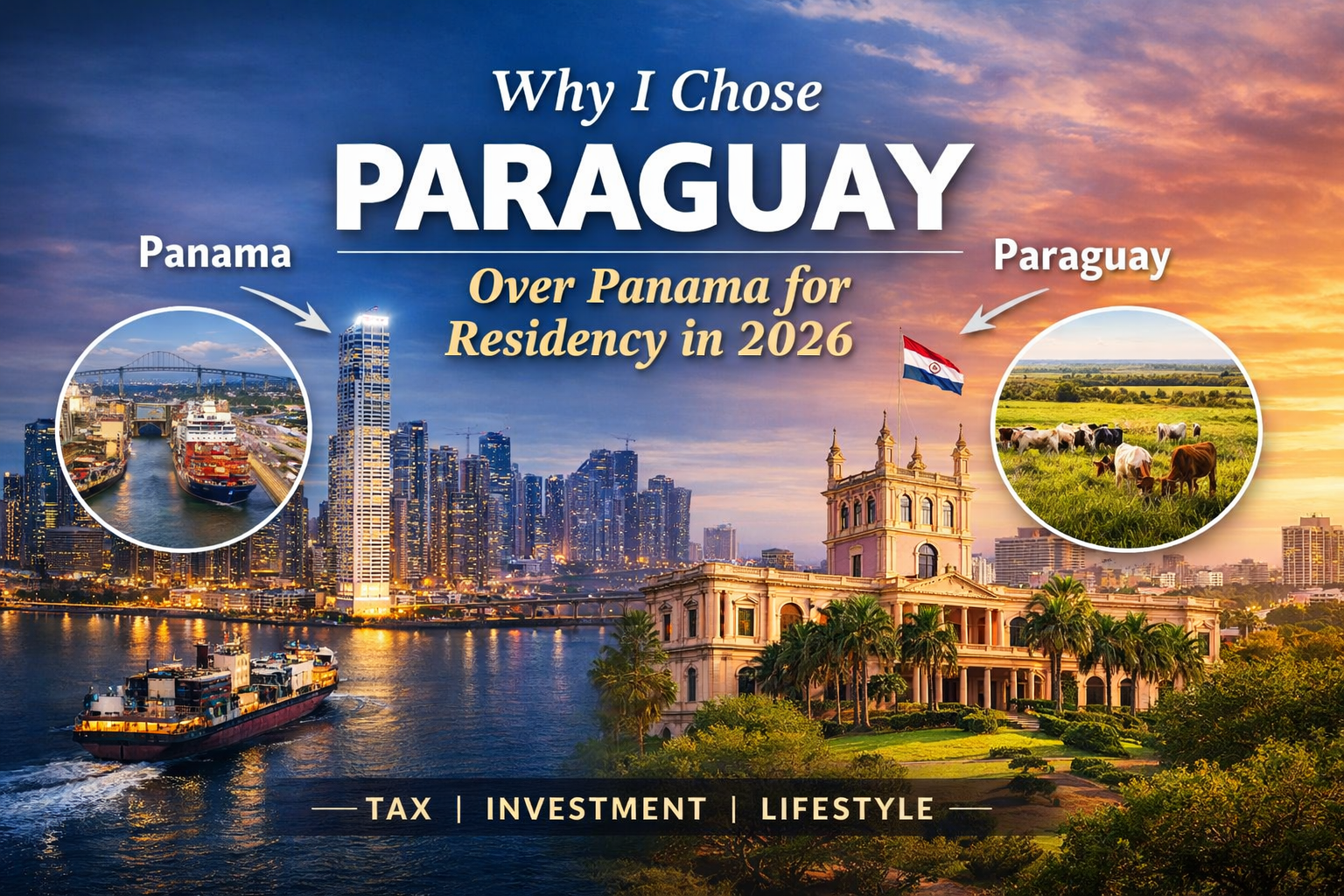
A Strategic Comparison of Tax Systems, Investment Potential and Long-Term Stability
For years, Panama has been one of the most recognizable residency jurisdictions in Latin America. The Friendly Nations Visa program, combined with the country’s territorial tax system and strong banking reputation, positioned it as a gateway for global entrepreneurs and retirees.
Paraguay, by contrast, remained largely outside mainstream international discussion. It was perceived as quieter, less developed, and less internationally integrated.
Yet after a structured evaluation of tax systems, compliance trends, real estate cycles, geopolitical exposure, and long-term capital positioning, I concluded that Paraguay offered a more strategically aligned residency base for my objectives in 2026.
This decision was not based on emotion or trend-following. It was based on structural analysis.
Residency Requirements: Regulatory Trajectory Matters
Panama’s Friendly Nations Visa once represented one of the most straightforward residency pathways in the region. However, regulatory updates over recent years significantly increased the barriers to entry.
Applicants today often face:
- Higher minimum investment thresholds
- Real estate purchase requirements typically starting around $200,000
- Increased documentation scrutiny
- Greater emphasis on economic substance
- Longer processing timelines
Panama remains accessible, but it is no longer “light-touch.” The country has gradually aligned its regulatory framework with international transparency and compliance expectations.
Paraguay’s residency framework, in contrast, remains administratively simple and procedurally predictable. The process typically requires:
- Clean criminal background documentation
- Standard civil records (birth and, where applicable, marriage certificates)
- In-person filing
- Issuance of a national identification card (cédula) following approval
The procedure is bureaucratic rather than political. It is document-based, not investment-escalating.
For individuals seeking a second residency without tying it directly to large capital deployment or complex corporate structuring, Paraguay offers administrative clarity.
Territorial Taxation: Theory vs. Practical Exposure
Both Panama and Paraguay operate territorial tax systems, meaning that foreign-sourced income is not taxed domestically.
However, the effectiveness of a territorial system depends not only on legislation but on international positioning, enforcement patterns, and reputational exposure.
Panama
Panama has historically maintained a strong banking sector and international financial infrastructure. At the same time, it has faced global scrutiny over the past decade. Inclusion on monitoring lists and international compliance pressures have increased regulatory tightening and reputational complexity.
While Panama still offers a legitimate territorial framework, operating there increasingly requires careful structuring and professional guidance, especially for higher-profile individuals.
Paraguay
Paraguay also applies territorial taxation:
- Foreign income is not taxed
- Local income is taxed at competitive rates
- Corporate taxation remains moderate
- VAT structure is straightforward
Crucially, Paraguay is not under the same level of international financial scrutiny as Panama. Its lower global visibility reduces reputational noise.
For some investors, Panama’s developed financial ecosystem is a strength. For others, Paraguay’s lower exposure and simpler compliance environment are strategically preferable.
The choice depends on risk profile and visibility tolerance.
Real Estate Cycle Positioning: Mature vs. Early-Stage Markets
A central component of residency strategy often involves real estate exposure. Here, the difference between Panama and Paraguay becomes particularly clear.
Panama
Panama City’s prime districts regularly command prices between $2,000 and $3,500 per square meter or more. The market is:
- Internationally marketed
- Developer-driven
- Expat-heavy
- Relatively mature
Mature markets offer stability but typically lower asymmetrical upside. Entry costs are higher, and yield compression has already occurred in many segments.
Paraguay (Asunción)
Asunción’s prime districts remain significantly below Panama’s pricing levels. The city is in an earlier development phase characterized by:
- Expanding middle-class demand
- Urban modernization
- Limited foreign speculative capital
- Gradual infrastructure improvement
Early-cycle markets often present stronger appreciation potential relative to entry cost. They also require patience and long-term vision.
For investors prioritizing asymmetric opportunity rather than established expat ecosystems, Paraguay represents a structurally earlier stage.
Cost of Living and Capital Efficiency
Lifestyle costs directly impact capital preservation.
Panama is no longer a low-cost jurisdiction. Housing, schooling, international goods, and lifestyle services have risen significantly over the past decade.
Paraguay remains structurally more affordable:
- Lower residential costs
- Lower service pricing
- Competitive private healthcare
- Reduced lifestyle inflation
A lower personal expenditure baseline increases optionality. Investors able to maintain residency at lower recurring costs retain greater flexibility in capital allocation.
Over a 10–20 year horizon, this difference becomes meaningful.
Banking, Reputation and International Perception
Panama’s banking sector is deeper and more internationally integrated. For some profiles—particularly those operating logistics, shipping, or regionally structured businesses—this can be an advantage.
However, Panama’s historical association with offshore exposure has increased scrutiny.
Paraguay’s banking system is smaller and less internationally visible. While not as globally integrated, it also carries less reputational complexity.
For individuals seeking a discreet, lower-profile residency jurisdiction rather than a global financial hub, Paraguay’s quieter positioning may align better with long-term privacy strategy.
Geopolitical and Structural Risk
Panama’s economy is strongly linked to:
- Canal revenue
- International trade
- U.S. strategic interests
This creates resilience but also exposure to global trade dynamics.
Paraguay’s economy is driven primarily by:
- Agriculture exports
- Energy production (hydroelectric)
- Regional trade
It is landlocked and geopolitically less entangled. Political continuity has been relatively stable over recent decades.
For investors diversifying globally, Paraguay offers lower systemic exposure to major geopolitical power tensions.
Social and Lifestyle Considerations
Panama offers:
- Larger English-speaking infrastructure
- Established expat networks
- More internationally oriented urban centers
Paraguay offers:
- Strong local cultural continuity
- Slower urban rhythm
- Deep community structures
- Lower expat saturation
Panama functions as a regional hub.
Paraguay functions as a stable base.
This distinction is often overlooked but matters significantly for long-term residency comfort.
Strategic Framing: Popularity vs. Asymmetry
Panama is well known. It is widely marketed, frequently recommended, and globally discussed.
Paraguay remains underexposed.
In capital markets and residency planning alike, the difference between entering a mature narrative and positioning early in a quieter jurisdiction can shape long-term outcomes.
Panama represents maturity and infrastructure.
Paraguay represents asymmetry and early positioning.
Neither is universally superior.
The relevant question is alignment.
Who Should Consider Panama Instead?
Panama may be preferable for individuals who:
- Require strong English-speaking infrastructure
- Operate internationally integrated businesses
- Value immediate global connectivity
- Prefer larger expat communities
- Prioritize banking depth over lower visibility
Panama is not inferior. It is simply more globally integrated—and more priced accordingly.
Why Paraguay Aligned Better with My Strategy
My criteria in 2026 included:
- Territorial taxation clarity
- Lower administrative complexity
- Early-stage real estate positioning
- Lower capital entry requirements
- Reduced geopolitical entanglement
- Long-term optionality
Paraguay met these criteria more efficiently.
It allowed residency establishment without large forced capital allocation. It provided exposure to an emerging urban real estate cycle. It offered lower recurring lifestyle costs and a quieter international profile.
Strategically, it aligned with long-term diversification rather than short-term prestige.
Final Assessment: Strategy Over Popularity in 2026
Choosing a second residency in 2026 is not about following headlines or selecting the most internationally marketed jurisdiction. It is about structural alignment — how a country’s legal framework, tax system, economic trajectory, and geopolitical exposure integrate with your broader capital strategy.
A well-designed residency decision should support:
- Long-term tax efficiency
- Asset protection and diversification
- Regulatory predictability
- Personal mobility
- Sustainable lifestyle costs
In that context, Panama remains a credible and functional residency jurisdiction. It offers infrastructure, international connectivity, and a developed expat ecosystem. For certain profiles — particularly entrepreneurs operating regionally integrated businesses or individuals prioritizing global connectivity — Panama may remain the optimal choice.
However, for investors evaluating Panama vs Paraguay residency through a strictly strategic lens, the equation shifts.
Paraguay presents a compelling alternative for those seeking:
- Administrative simplicity without escalating compliance layers
- Lower capital entry thresholds for residency positioning
- Emerging-market asymmetry in real estate and economic growth
- Reduced international scrutiny and geopolitical exposure
- Long-term strategic optionality rather than short-term prestige
While Panama represents maturity and global integration, Paraguay represents early-cycle positioning and structural discretion.
The distinction is not about which country is “better.” It is about which jurisdiction aligns more precisely with your:
- Risk tolerance
- Investment horizon
- Tax planning architecture
- Capital preservation strategy
- Lifestyle preferences
In a world of increasing regulatory complexity and geopolitical volatility, alignment becomes more important than popularity.
For my long-term residency and diversification strategy in 2026, Paraguay offered that alignment — not because it is widely promoted, but because its structural characteristics matched my objectives more closely.
Second residency is not a branding decision.
It is a capital allocation decision
FAQ: Paraguay Over Panama for Residency
1. Why are investors choosing Paraguay over Panama for residency in 2026?
Investors are increasingly choosing Paraguay over Panama for residency due to lower capital entry requirements, administrative simplicity, and early-stage real estate opportunities. While Panama remains more internationally integrated, Paraguay offers a quieter jurisdiction with territorial taxation and lower overall compliance complexity. For individuals prioritizing strategic positioning over brand recognition, Paraguay may present a more efficient long-term option.
2. Is Paraguay residency easier than Panama residency?
In practical terms, yes. Paraguay residency generally involves fewer mandatory investment thresholds and less regulatory layering compared to modern Panama programs. Panama’s updated residency pathways often require real estate investments or corporate structures. Paraguay’s process remains documentation-based and procedurally straightforward.
3. How does the tax system compare when choosing Paraguay over Panama for residency?
Both countries operate territorial tax systems, meaning foreign-sourced income is typically not taxed locally. However, Panama faces greater international scrutiny and regulatory tightening, while Paraguay maintains a lower-profile fiscal environment. For some investors, that distinction influences long-term strategic decisions.
4. Is Paraguay safer than Panama for long-term residency planning?
Both countries are politically stable within the Latin American context. However, Paraguay is less geopolitically exposed and less dependent on global trade infrastructure compared to Panama, whose economy is closely linked to canal operations and international logistics. From a diversification perspective, Paraguay may offer lower systemic exposure.
5. What about real estate investment when choosing Paraguay over Panama for residency?
Real estate pricing in Panama City is significantly higher and reflects a more mature market cycle. Asunción, Paraguay, remains in an earlier development phase, with lower entry prices and potentially stronger long-term appreciation potential. Investors seeking asymmetric upside may therefore consider Paraguay strategically attractive.
6. Who should still choose Panama instead of Paraguay?
Panama may be better suited for individuals who:
- Require strong English-speaking infrastructure
- Operate internationally integrated businesses
- Prefer a large expat ecosystem
- Prioritize global connectivity and banking depth
Paraguay is often better aligned with investors focused on simplicity, lower capital thresholds, and emerging-market positioning.
7. Is Paraguay over Panama for residency a long-term strategy or a short-term trend?
Choosing Paraguay over Panama for residency is generally a structural decision rather than a trend-based one. It reflects preferences regarding tax planning architecture, cost efficiency, regulatory exposure, and long-term capital diversification rather than lifestyle marketing narratives.